Written by the PetFitness team and reviewed by our Certified Canine Fitness Trainers. Last updated November 25, 2026.
An old dog’s back legs get weak for one of two reasons. Either the dog is losing muscle, or something is getting in the way of the joints or nerves that drive those legs. Most cases come on slowly and turn out to be arthritis, age-related muscle loss, or both together. Weakness that appears suddenly, or legs that give out with no warning, is a different situation and needs a vet the same day.
This guide covers how to tell the slow kind from the urgent kind, the most common causes, what to do first, and six exercises that rebuild hind leg strength once your vet has cleared your dog.
The short version
- Slow and gradual: weakness that builds over weeks or months is usually arthritis, muscle loss, or both. Book a vet visit, then start strength work.
- Sudden: collapse, dragging, crying out, or loss of bladder control means vet today.
- Rest is not the fix: an old dog that stops moving loses muscle faster, and muscle is what holds the back end up.
- Start tonight: put rugs on slippery floors and do three slow sit-to-stands.
When weak back legs are an emergency
Call your vet or an emergency clinic the same day if you see any of these:
- Your dog suddenly cannot stand, or the back legs are dragging.
- Your dog cries out, trembles, or will not let you touch its back or hips.
- New loss of bladder or bowel control.
- The weakness appeared within hours or a day or two.
- Collapse with pale gums, heavy panting or confusion.
- The weakness followed a fall, a jump or a collision.
If none of those apply and the change has been gradual, you have time to book a normal appointment. Do still book it. The exercises below are for dogs whose vet has said exercise is safe.
Why do old dogs’ back legs get weak?
These are the causes vets see most often in older dogs. More than one can be present at once.
| Cause | What it usually looks like | Painful? | How it starts |
|---|---|---|---|
| Arthritis | Stiff after rest, slow to get up, better once warmed up, worse after a big day | Yes | Gradually |
| Age-related muscle loss | Thinner thighs, hip bones and spine easier to feel, tires quickly | No | Gradually |
| Degenerative myelopathy | Wobbling, scuffed back nails, paws knuckling under, legs crossing | Usually not | Gradually, often one leg first |
| Disc or spine problems | Hunched back, reluctance to jump, weakness or dragging | Often | Suddenly or gradually |
| Hip dysplasia or knee ligament injury | Bunny hopping, sitting with a leg out to the side, limping | Yes | Gradually or after an injury |
| Illness elsewhere in the body | General weakness, tiring fast, drinking or eating changes | Varies | Varies |
Arthritis
Arthritis is the most common joint disease in dogs. A figure often quoted in veterinary research is that about 20% of dogs over one year old have it, and it gets more common with age. Many cases go unnoticed. In one study, vets confirmed arthritis in 38% of 500 dogs whose owners had only ticked a box on a mobility checklist. A dog with sore hips or knees uses its back legs less, and the muscle shrinks from lack of use.
Age-related muscle loss
Vets call this sarcopenia: the loss of lean body mass that comes with aging, even when no disease is present. It is described in the veterinary literature as a growing concern in older dogs. It starts earlier than most owners expect. In a study of 1,273 dogs, lean mass rose until about 6.3 years of age and then slowly declined. You see it first in the thighs and along the spine.
Degenerative myelopathy
Degenerative myelopathy (DM) is an inherited disease of the spinal cord. According to Cornell’s Riney Canine Health Center, it typically affects dogs around eight years or older and often starts in one hind leg before moving to both. Breeds at higher risk include German Shepherds, Boxers, Pembroke Welsh Corgis, Chesapeake Bay Retrievers, Rhodesian Ridgebacks and Bernese Mountain Dogs. There is no cure, but Cornell notes that routine physical therapy may slow its progression.
Other causes
Disc disease, narrowing at the base of the spine, spinal tumors and spinal strokes can all weaken the back legs, and several of them need fast treatment. Joint problems are common too. If your dog has a diagnosis already, see our guides to hip dysplasia exercises and torn ACL in dogs.
How to check your dog for muscle loss
Muscle loss is easy to miss under a thick coat, and a dog can be losing muscle while its weight stays the same or even goes up. Vets score muscle separately from body fat for this reason. You can do a rough check at home in two minutes.
- Feel the thighs. Stand behind your dog and wrap a hand around each thigh at the same height. They should feel firm and even. A thigh that feels soft, flat or smaller than the other is worth showing your vet.
- Run a hand along the spine and hips. If the spine and hip bones feel sharper than they did a year ago, the muscle beside them has thinned.
- Measure. Put a soft tape measure around the top of each thigh, at the same spot each time, with your dog standing. Write the number down once a week.
- Take a photo from behind once a month. Slow change is easier to see in pictures than day to day.
Muscle atrophy in dogs has two broad causes. Disuse atrophy happens when a dog stops using a leg because it hurts or because the dog has been resting. It often shows up in one leg more than the other, and it can be rebuilt. Atrophy from nerve disease happens when the nerves stop telling the muscle to work. It tends to affect both back legs and is much harder to reverse, which is why the diagnosis matters.
Arthritis or degenerative myelopathy?
Early DM looks a lot like arthritis, which is why VCA Animal Hospitals describes it as hard to diagnose at first. Only your vet can tell them apart, and a dog can have both. These differences are worth mentioning at the appointment.
| What you notice | Points toward arthritis | Points toward DM |
|---|---|---|
| Pain | Sore, stiff, may lick joints | Usually not painful, just weak |
| After resting | Stiff at first, loosens up with movement | No better after warming up |
| Back paws | Placed normally | Knuckle under or scuff, nails worn on top |
| Standing still | Shifts weight off the sore leg | Hindquarters sway, falls over if nudged |
| Walking | Shorter stride, limping | Wobbly, legs cross, feet scrape |
Weak back legs by size and breed
Any dog can lose strength in the back end, but the likely cause shifts with body type. Use this as a prompt for your vet visit. It is not a diagnosis.
| Dog type | More likely to see | Good to know |
|---|---|---|
| Large and giant breeds (Labradors, Golden Retrievers, Rottweilers) | Arthritis in the hips and knees, hip dysplasia | Extra body weight makes all of it worse |
| German Shepherds, Boxers, Corgis and other breeds prone to DM | Degenerative myelopathy, often alongside arthritis | A genetic test can show whether your dog carries the variants linked to DM |
| Long-backed breeds (Dachshunds, Basset Hounds) | Disc problems | Sudden weakness in these breeds is urgent |
| Small breeds | Loose kneecaps, disc problems | Often shows up as skipping or hopping on a back leg |
What to do first
- Book a vet exam. Before you go, film your dog on your phone: walking toward you, away from you and from the side, plus getting up from lying down. Video shows your vet what your dog hides in the exam room.
- Fix the floors today. Put rugs, runners or yoga mats on every slippery surface your dog crosses. A dog that slips stops trusting its back legs.
- Check your dog’s weight. Every extra pound is more work for weak legs. In a long-term study of Labrador retrievers, dogs kept lean lived nearly two years longer than their heavier littermates. Our 9-point body condition check takes two minutes.
- Keep moving, gently. Swap one long walk for two or three short ones. Do not switch to full rest unless your vet tells you to.
What your vet will check
Knowing what to expect makes the visit more useful. A typical work-up for weak back legs looks like this:
- A hands-on exam of the hips, knees and spine, looking for pain, swelling and stiffness.
- A neurological check. One simple test is turning a back paw over so the top touches the floor. A healthy dog flips it back right away.
- X-rays of the hips, knees and spine.
- Blood work, to rule out illness elsewhere in the body.
- MRI or CT, if a spinal problem is suspected.
No single test confirms degenerative myelopathy in a living dog. Cornell explains that vets diagnose it by ruling out other spinal conditions, and that a genetic test can show whether a dog carries the variants linked to it.
Ask three questions before you leave: what is the diagnosis, is exercise safe, and is there anything my dog should not do.
Does exercise help weak back legs?
For the slow causes, yes. Movement is how muscle is kept, and muscle is what supports a weak or sore joint.
The best-known evidence comes from dogs with suspected degenerative myelopathy. In a 2006 study of 22 dogs, those given intensive daily physiotherapy survived an average of 255 days. Dogs given moderate physiotherapy averaged 130 days, and dogs given none averaged 55 days. It was a small study, so treat the exact numbers with care. The direction is clear, and it matches Cornell’s advice that physical therapy helps a dog keep its muscle.
6 exercises to strengthen an old dog’s back legs
Get your vet’s OK first. Work on a non-slip surface, keep sessions to a few minutes, and stop when your dog’s form gets sloppy. Slow and controlled beats fast.
| Exercise | Start with | Build to | How often |
|---|---|---|---|
| Sit-to-stand | 3 slow reps | 10 reps | 1 to 2 times a day |
| Weight shifts | 5 each side, 3-second hold | 10 each side, 5-second hold | Daily |
| Slow leash walks | 5 minutes on flat ground | 10 to 15 minutes, gentle slopes | 2 to 3 times a day |
| Backing up | 3 steps, 3 times | 5 to 8 steps, 5 times | Most days |
| Front feet up | 10-second hold, 3 times | 20-second hold, 5 times | Most days |
| Low poles | 4 poles on the ground, 3 passes | 6 poles raised a few inches, 5 passes | 3 times a week |
1. Sit-to-stand
This is a squat for dogs. Ask for a sit, then a stand, and reward the stand. Watch that your dog sits square, with both back legs tucked under, and pushes up with the back legs instead of hauling itself forward with the front. If your dog flops to one side, do it beside a wall.
2. Weight shifts
With your dog standing square, place a hand on each hip and nudge gently to one side until you feel the legs push back. Hold for a few seconds, then go the other way. It should look like almost nothing is happening. The small stabilizing muscles around the hips are doing the work.
3. Slow leash walks
Slow is the point. At a slow walk each back leg has to carry weight on its own for longer. Use a leash so your dog cannot rush. Once flat ground is easy, add a gentle uphill, which loads the back legs more.
4. Backing up
Stand facing your dog in a hallway and step toward it until it steps back. Reward each step. Walking backward makes a dog think about where its back feet are.
5. Front feet up
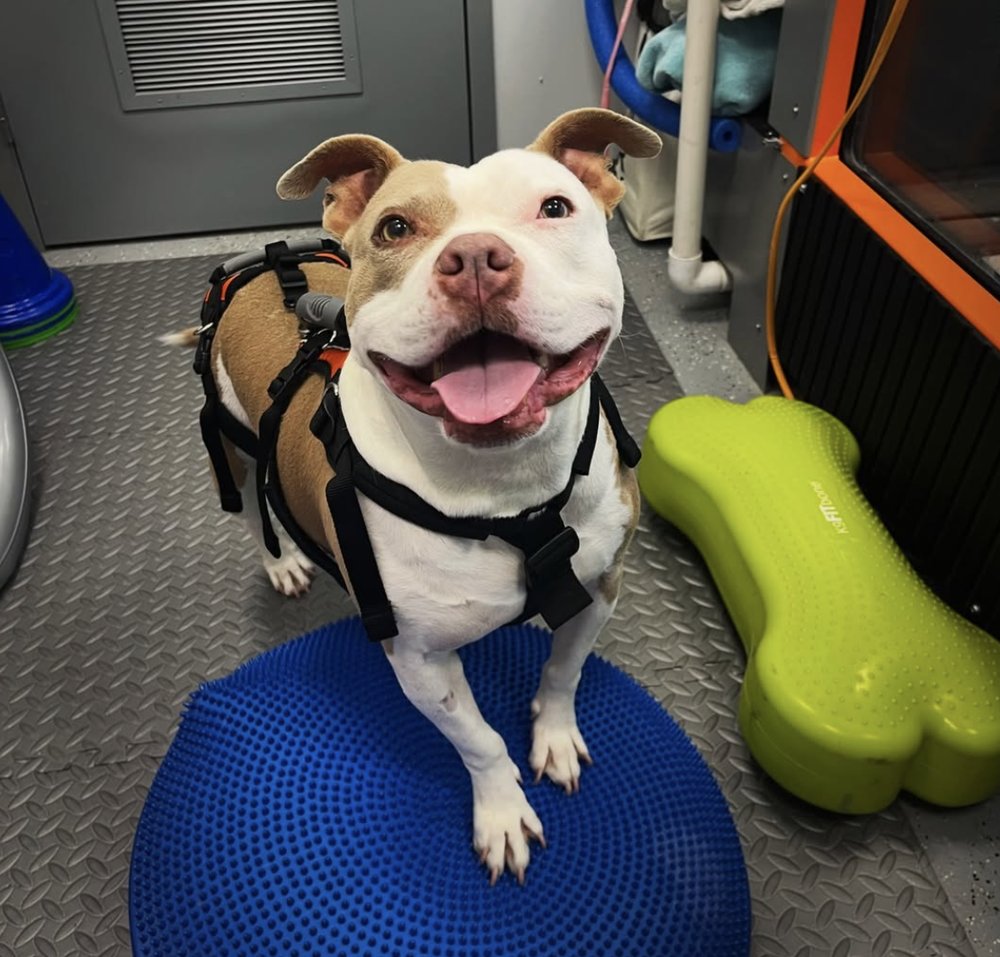
Lure your dog’s front paws onto a low, stable step or a thick book, and have it stand there. Raising the front end shifts weight onto the back legs. Start low. A few inches is enough for most senior dogs.
6. Low poles
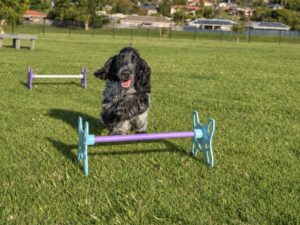
Lay broom handles or pool noodles on the ground about one dog-length apart and walk your dog over them slowly. Your dog has to lift each back foot instead of shuffling. Our dog cavaletti guide covers spacing and height by dog size.
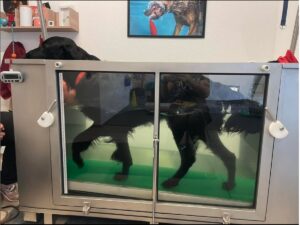
For more options, see how to build muscle on a dog and our low-impact exercises for senior dogs. If you have access to warm water, hydrotherapy lets a weak dog work its legs with less weight on them.
A 4-week starter plan
This is a gentle starting point for a dog whose vet has cleared it for exercise. Move to the next week only if your dog finished the current one without limping, soreness the next morning, or sloppy form.
| Week | Every day | Add this week |
|---|---|---|
| Week 1 | 3 sit-to-stands, two or three 5-minute slow walks | Rugs down, nails trimmed |
| Week 2 | 5 sit-to-stands, weight shifts 5 each side, walks of 5 to 8 minutes | Nothing new |
| Week 3 | 6 to 8 sit-to-stands, weight shifts, walks of 8 to 10 minutes | Backing up and front-feet-up holds, every other day |
| Week 4 | 8 to 10 sit-to-stands, weight shifts, 10-minute walks with a gentle slope | Low poles, 3 times a week |
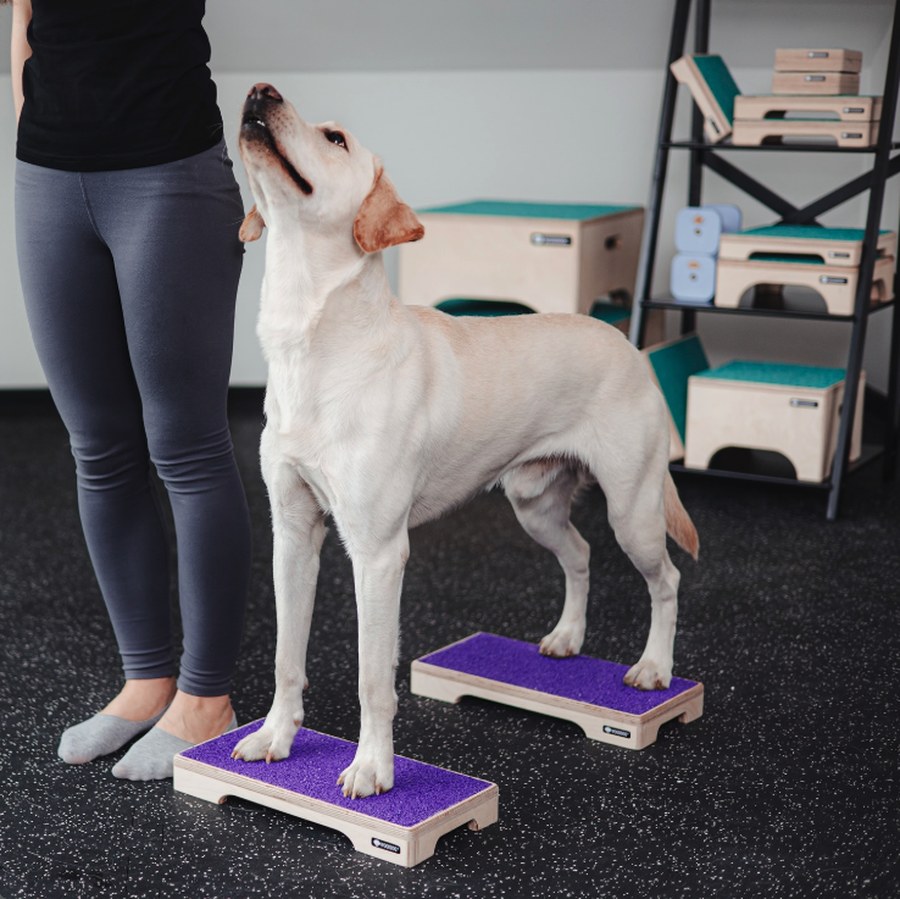
If your dog struggles at any stage, repeat that week. Progress in old dogs is rarely a straight line, and holding steady counts as a win when the alternative is losing ground. Once the four weeks feel easy, our guides to dog balance exercises and dog stretching are good next steps.
Set the house up for weak back legs
- Traction: rugs or runners on hard floors, especially at turns, by the bed and at the food bowl.
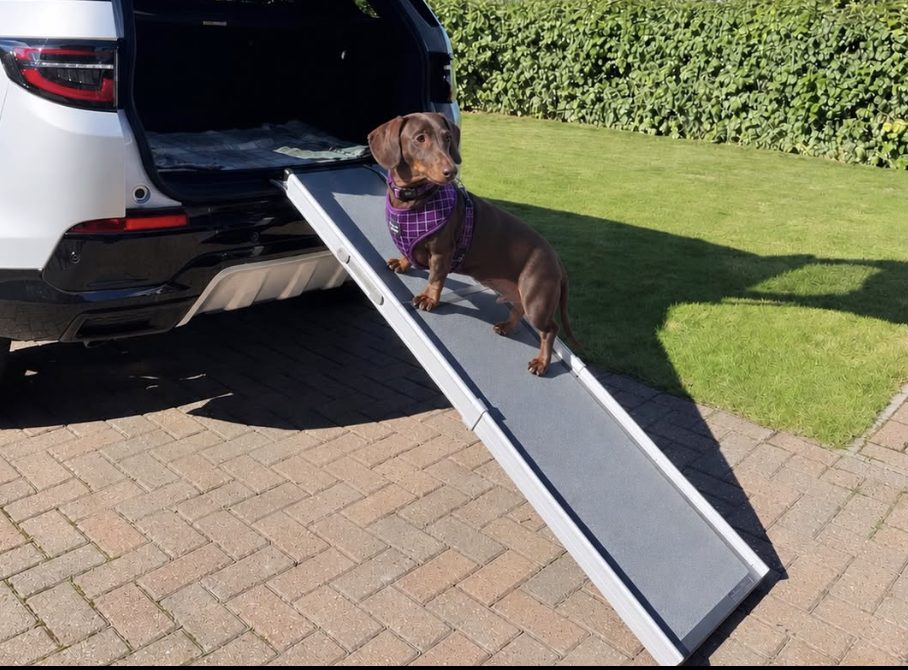
- Ramps or steps: for the car, the couch and the bed, so your dog is not jumping down onto weak legs.
- A rear-support harness: a handle over the hips lets you steady your dog on stairs and during exercise.
- Nails and paw fur: keep nails short and trim the fur between the pads. Long nails and furry feet slide.
- Booties: if your dog scuffs the tops of its back paws, booties protect the skin.
Harness, sling or wheelchair?
| Tool | Best for | Good to know |
|---|---|---|
| Rear-support harness | Dogs that walk on their own but need steadying on stairs, in the car and on slick floors | Look for a handle over the hips. It can stay on during the day. |
| Sling | Short-term help, such as trips outside after an injury | Cheap and quick, but tiring to use every day |
| Wheelchair | Dogs that can no longer walk more than a few steps unaided | Supports the back end so your dog can keep moving. Ask your vet about fit. |
What not to do
- Do not rest your dog completely unless your vet prescribes it. Muscle goes quickly in an old dog that stops moving.
- Do not save exercise for the weekend. One long hike after five quiet days is how old dogs get hurt.
- Do not play fetch on slippery floors, and skip games with sharp turns and sudden stops.
- Do not rely on supplements alone. No supplement rebuilds muscle that is not being used.
- Do not push through pain. Limping, panting hard, or refusing a movement means stop and tell your vet.
How long until you see a change?
Think in weeks. Give a consistent routine at least a month before you judge it. Track three things once a week: how easily your dog gets up, how many sit-to-stands it can do with good form, and how far it walks before the back end starts to sway. If things get worse despite steady work, go back to your vet.
Frequently asked questions
Why are my old dog’s back legs suddenly collapsing?
Sudden collapse is not normal aging. It can come from a slipped disc, a spinal stroke, an injury, or an illness somewhere else in the body. Treat it as urgent and call your vet the same day, even if your dog gets back up.
Can an old dog recover from weak back legs?
It depends on the cause. Weakness from arthritis and muscle loss often improves with treatment, weight control and steady strength work. Degenerative myelopathy has no cure, but exercise is still part of managing it. Your vet’s diagnosis tells you which of these you are dealing with.
Is walking good for a dog with weak back legs?
Usually yes, once your vet has cleared it. Short, slow walks on flat ground several times a day are better than one long walk. Stop before your dog starts to drag its feet or sway.
How can I strengthen my old dog’s hind legs at home?
Start with sit-to-stands on a rug, gentle weight shifts, and short slow walks. Add backing up, front-feet-up holds and low poles as your dog gets steadier. Keep sessions to a few minutes and do them most days.
At what age do dogs’ back legs get weak?
There is no set age. In one study of more than 1,200 dogs, lean body mass rose until about age six and then slowly declined. Degenerative myelopathy typically appears at around eight years or older. Large breeds tend to show weakness earlier than small ones.
Should I get a harness or wheelchair for my dog?
A rear-support harness helps as soon as your dog struggles with stairs, the car or slippery floors, and it lets you keep exercising safely. A wheelchair is worth discussing with your vet when your dog can no longer walk on its own for more than a few steps.
Is muscle atrophy in dogs reversible?
Often, yes, when the cause is disuse. Once pain is treated and the dog starts using the leg again, steady strength work can rebuild muscle over weeks to months. Muscle lost to nerve disease is much harder to regain, but exercise still helps a dog keep what it has.
Should I massage my old dog’s back legs?
Gentle massage before exercise helps warm the muscles, and it is a good way to notice changes in muscle size. It does not replace strength work. Skip any area that is hot, swollen or painful, and ask your vet first if your dog has a spinal condition.
Where this fits in your dog’s plan
The exercises above are a safe start, but the right mix and dose depend on your dog’s diagnosis, weight and how it moves. That is what the Senior Dog Strength Program is for: a 30-minute video consult, a plan built for your dog, and 12 weeks of support from your trainer. Vet clearance comes first. If you would rather start on your own, put the rugs down tonight, do three sit-to-stands, and book the vet visit this week.